v3.6Now on Android: Single Player mode · team profiles · sort by any statCheck it out
All help guides
The common player: one player on both teams
Full Match
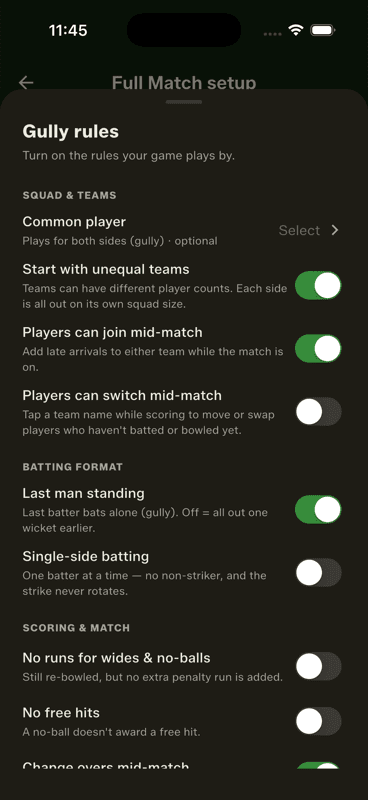
In Full Match setup, use the Common player row in Gully Rules to pick one player who plays for both sides. They can bat and bowl for either team, and their career still counts as one player.
Nine people at the ground means 4 v 4 with one left over — so the spare plays for both sides. Every gully has done it; the app just makes the scorebook agree.
Setting it up
In the Gully Rules sheet, the Common player row sits at the top of Squad & Teams. Pick the player and they appear in both lineups, marked with a badge in the lineup editor so nobody wonders why the same name is on both sheets.
The Common player row leads the Squad & Teams section — tap Select to pick who plays for both sides.
How their stats work
They are one player, not two. Runs scored for Team A and wickets taken for Team B all land on the same career — the scorecard shows them in both innings, and the Squad Book adds it up as a single record.
The common player is optional and per-match: pick someone this Sunday, nobody next Sunday.
People also ask
What is the common player rule in gully cricket?
One player turns out for both teams — batting and bowling for each side — used when numbers are odd. Their runs and wickets all belong to the same person.
Can one player play for both teams in cricket?
Not in the formal game, but it is a standard gully solution to an odd number of players. Gully Crix lets you designate a common player at match setup.
How are stats counted for a player on both teams?
As one career. Runs scored for one side and wickets taken for the other land on the same record, and the scorecard shows them in both innings.