v3.6Now on Android: Single Player mode · team profiles · sort by any statCheck it out
All help guides
Overs, max overs per bowler, arena and ball explained
Quick MatchFull Match
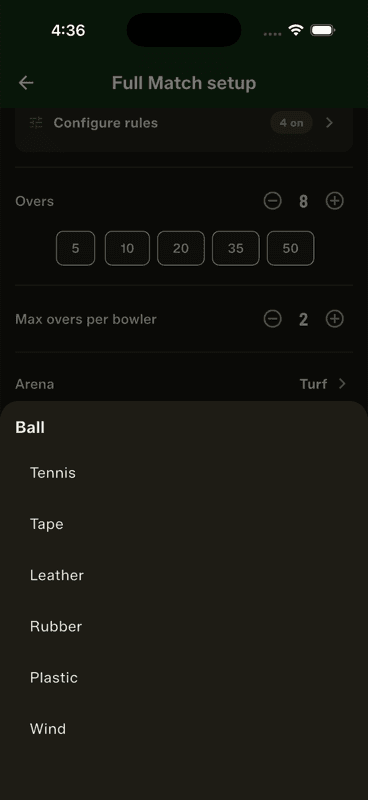
Overs sets the innings length. Max overs per bowler caps how much any one bowler can send down. Arena (turf, ground, street, mohalla, stadium) and ball (tennis, tape, leather, rubber, plastic, wind) tag the match so you can filter career stats later.
Overs
Pick from the presets or set any number with the plus and minus. Quick Match offers 6 through 50 plus a custom option; Full Match uses the same control. Turn on Change overs mid-match if you might need to shorten or extend the game once it has started.
Max overs per bowler
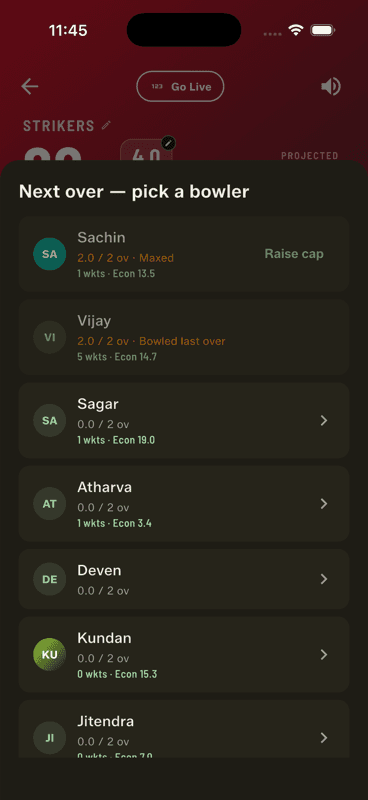
The cap that stops one bowler bowling the whole innings. When someone reaches it, the bowler picker marks them Maxed and won't let you choose them.
Maxed out mid-match? Raise cap lifts the limit for that one bowler without changing anyone else.
Raise cap is per player. Handy when half your bowlers have gone home and the last two overs still need bowling.
Arena and ball
Both are required in Full Match, and they are not decoration. Every match is tagged with them, so on a player's profile you can ask questions like "what is his strike rate with a tennis ball on turf?" and get a real answer.
Six ball types, because a tape-ball hundred is not a leather-ball hundred.
People also ask
What is max overs per bowler in cricket?
A cap on how many overs any one bowler may send down, so a single bowler cannot bowl the whole innings. In a 20-over game it is usually four.
Does ball type matter for cricket statistics?
It matters a lot. A tape-ball strike rate and a leather-ball strike rate are different statistics, which is why Gully Crix tags every match with the ball and lets you filter careers by it.
How many overs should a gully cricket match be?
Most gully games run 6 to 10 overs a side, short enough to fit several matches into an afternoon. Gully Crix offers presets from 6 to 50 plus a custom number.