Every Gully Cricket Rule, Explained: The Complete GullyCrix House-Rules Guide

Official cricket has a 42-law rulebook and a match referee to enforce it. Gully cricket has none of that. It has nine players who agreed to meet at 6, one decent bat, a lane the width of a pitch, and a very strong difference of opinion about what counts as out. Every mohalla, every backyard, every turf box has quietly written its own laws over the years — and every one of them has argued about those laws at least once a match.
GullyCrix was built to end those arguments the modern way: not by pretending gully cricket is professional cricket, but by taking the real house rules everyone already plays by and turning them into toggles you agree on before the toss. They all live in one place in the app — a card titled, honestly enough, "Gully Rules (Ignore for Pro Matches)" — split into three groups: Squad & Teams, Batting Format, and Scoring & Match. This guide walks through every rule in that sheet, in the order we added it, with what it does, how it changes a real gully, mohalla, backyard or turf game, and the reasoning for why it's there at all.

Why gully cricket needs its own rules
The official Laws of Cricket assume things gully cricket never has: twenty-two players, a boundary rope, a flat 22-yard pitch, umpires, and unlimited time. A mohalla game assumes almost the opposite — an odd number of players who turned up, a wall for third man, a ball that behaves nothing like a leather one, and roughly forty minutes before someone's mother calls them in. So gully cricket didn't break the rules; it wrote new ones to fit the constraints. Uneven teams needed a fix. A short lineup running out of batters needed a fix. A tennis ball that goes for a wide off every third delivery needed a fix. Each gully rule below exists to solve a real problem that only shows up when you play in the real world.
Every gully rule, in the order we added it
GullyCrix didn't launch with all of these — they arrived as players asked for them, release after release. Here's the timeline:
- 1Version 3.0 — Common Player and Last Man Standing: the two rules every gully already played.
- 2Version 3.2 — Start with unequal teams, Players can join mid-match, and Single-side batting: making a messy, real-world lineup work.
- 3Version 3.3 — Players can switch mid-match, No runs for wides & no-balls, No free hits, and Change overs mid-match: bending the scoring laws for the way tennis-ball cricket actually plays.
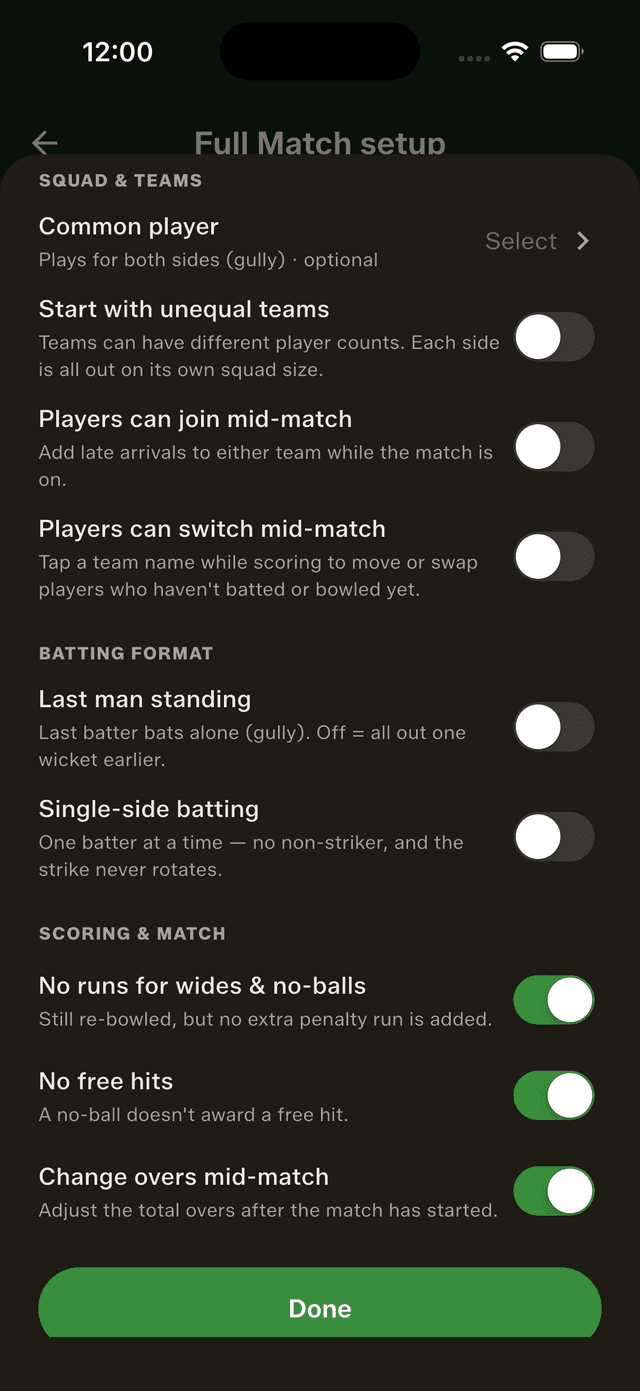
Squad & Teams: making an odd number of players work
Gully cricket's first and oldest problem is arithmetic. The right number of players almost never shows up, and the ones who do rarely arrive on time. This group of rules is about making a lopsided, drifting, real-world squad into a fair match.
1. Common Player (added in 3.0)
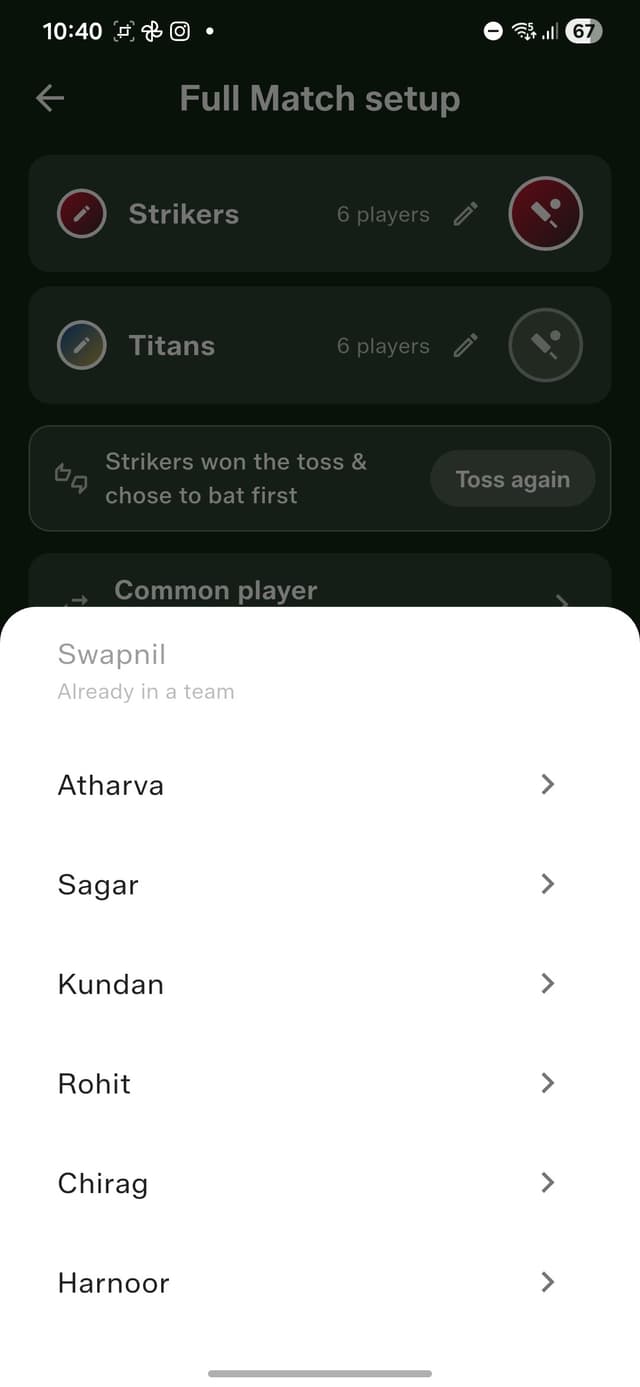
Nine players turn up. Four-versus-five is unfair and nobody wants to sit out, so gully cricket's oldest fix is to let one player bat for both sides. Usually it's the youngest, the latest to arrive, or — in the most diplomatic gullies — the best batter, so neither team feels robbed.
- •The Common Player bats for both teams, with their two innings scored completely separately — 20 for one side and 15 for the other are two different knocks.
- •In GullyCrix they can be anyone from your Squad Book, even a player who isn't in either team sheet.
- •It's the one rule in the sheet that isn't a toggle — it's a player picker, because you have to choose who.
Why it matters: in a backyard or mohalla game the Common Player is often the difference between a real match and everyone going home. It keeps an odd number playing without anyone warming the bench. We go deeper on this — and the arguments it causes — in Common Player & Last Man Standing, explained.
2. Start with unequal teams (added in 3.2)
Seven versus five is the most normal scoreline in gully cricket and the least normal in the rulebook. Turn this on and the two sides can simply have different player counts — each team is all out on its own squad size, and the result maths and the "won by N wickets" margin follow each side's real size instead of assuming they match.
Why it matters: it's the honest alternative to a Common Player when you'd rather just play the numbers you have. Nobody has to be borrowed; the smaller side simply has fewer wickets to give.
3. Players can join mid-match (added in 3.2)
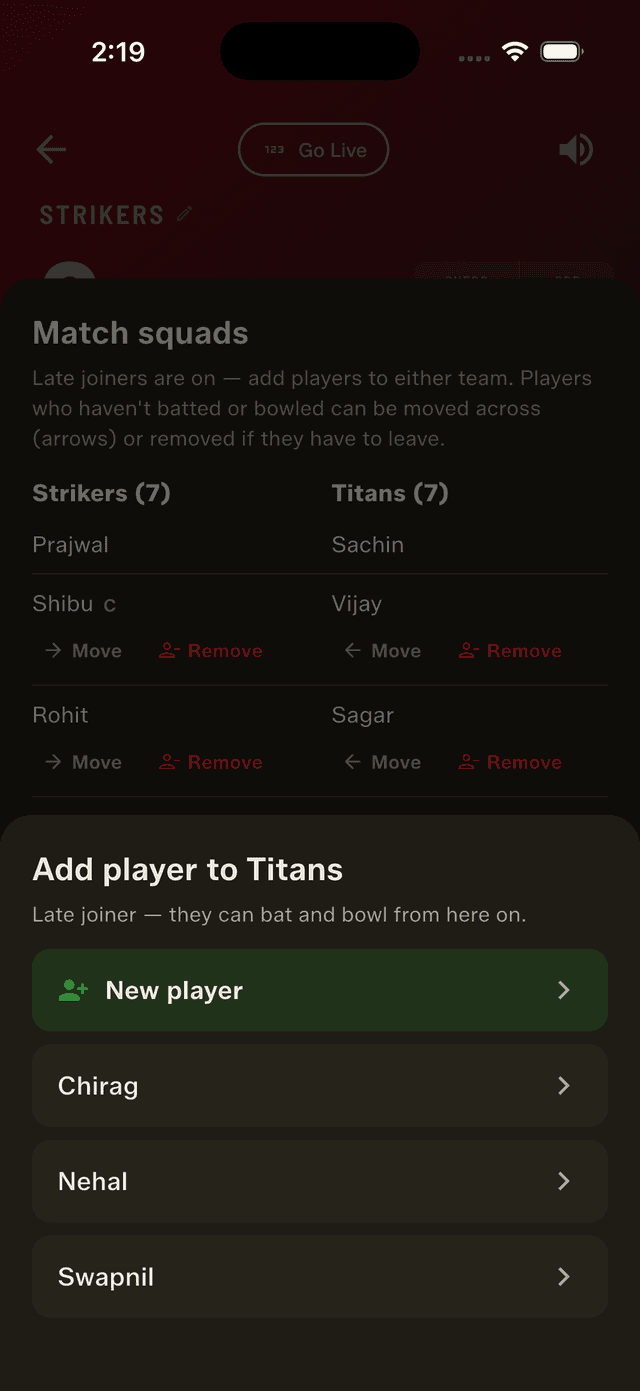
The lineup isn't locked once the first ball is bowled — because in real life the fourth and fifth players are still on their way. Switch this on and latecomers can join either team mid-match and bat and bowl from there on.
Why it matters: mohalla and turf games rarely start with everyone present. This rule means the match can begin on time with whoever's there, and absorb the stragglers as they wander in, instead of holding up the toss for the guy who's "two minutes away."
4. Players can switch mid-match (added in 3.3)
Sometimes the teams need rebalancing after they've started, or someone has to leave for dinner. With this on, you tap a team name while scoring to move a player to the other side or remove them — but only players who haven't batted or bowled yet, so nobody can quietly switch teams after failing. Turning it on is also what makes the team name editable mid-match.
Why it matters: it keeps a casual game fair and fluid without ever ending it. Real gully squads breathe in and out over an evening; the scoreboard should be able to breathe with them.
Batting Format: how far a short lineup can stretch
5. Last Man Standing (added in 3.0)
In official cricket, when the last wicket falls the innings ends — the final batter can't continue because there's no one to run with. Gully cricket looked at that and asked "why not?" When you've only five a side, ending an innings with a padded-up batter still waiting feels like a waste. So the last man bats alone, running both ends himself — twice the running for the same reward, which is exactly why the last man always swings for the trees.
- •It's the one gully rule that defaults on in a Full Match — because for most gullies it's simply how the game has always worked.
- •Turn it off and the innings ends one wicket earlier, the conventional way.
- •It produces the best comebacks in gully cricket — ask anyone who's watched a last man drag their team over the line alone.
Why it matters: in a short-format backyard game, a single batter can be a third of your total. Last Man Standing keeps the contest alive to the final ball instead of fizzling out with a spectator still holding a bat.
6. Single-side batting (added in 3.2)
For when only one side really bats, or you're simply a player short: single-side batting puts one batter at the crease at a time. There's no non-striker, the strike never rotates, and a new batter walks in after each wicket. Because every batter bats alone, Last Man Standing stays on and partnerships aren't shown for the match.
Why it matters: this is backyard and net cricket in its purest form — one batter, everyone else bowling and fielding, taking turns. It's also the honest way to score a knockabout where teams were never really the point.
Scoring & Match: bending the laws for a tennis ball
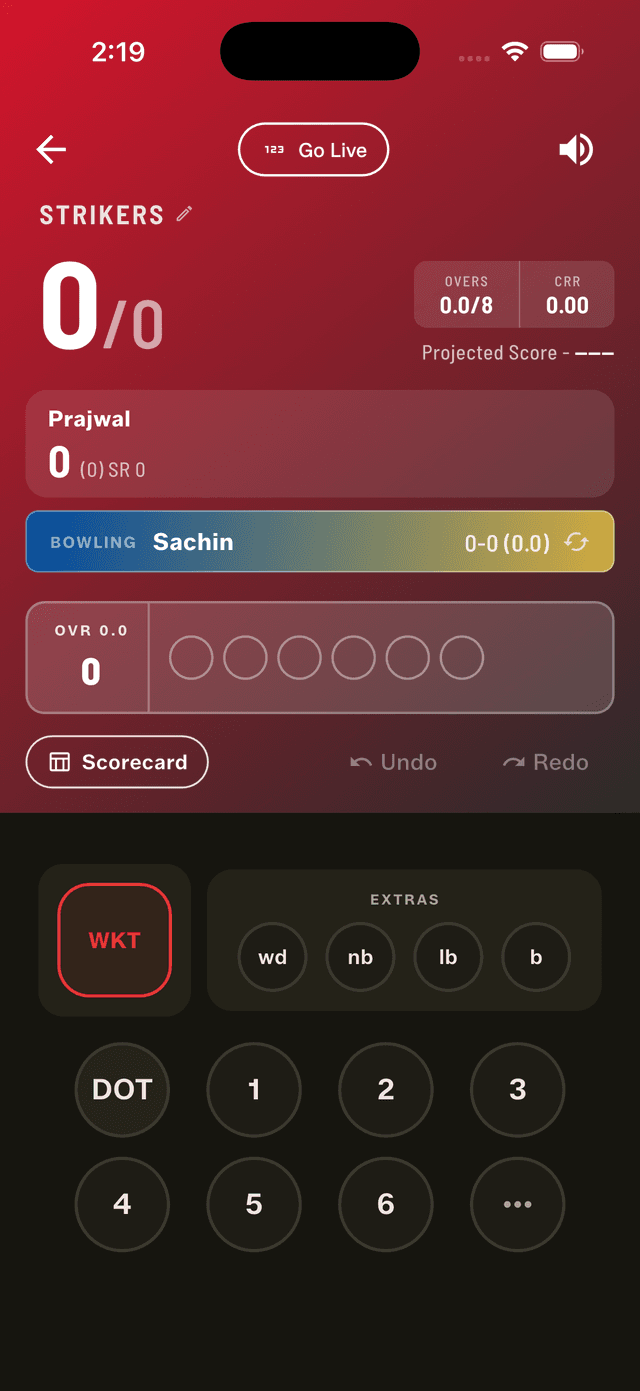
This last group is where gully cricket departs furthest from the rulebook — because a tennis or tape ball on a rough surface simply doesn't behave like a leather ball on turf. These three rules all work in both Quick Match and Full Match.
7. No runs for wides & no-balls (added in 3.3)
By default a wide or no-ball adds a penalty run and is re-bowled, just like real cricket. Turn this on and the ball is still re-bowled — you don't get away with a bad delivery — but no extra run is added.
Why it matters: with a tennis ball on an uneven street, genuinely straight bowling is hard, and a run-per-wide can quietly hand a chase away on extras alone. Plenty of mohalla games have always played "re-bowl it, but no run" for exactly this reason. Now the app can too.
8. No free hits (added in 3.3)
In the modern professional game a no-ball earns the batter a free hit. In a gully? Half the time nobody agrees a free hit is even a rule. Switch this on and a no-ball no longer arms a free hit — the next ball is just the next ball.
Why it matters: it's a small thing, but it's one of the most common "wait, do we play free hits?" arguments in casual cricket. Decide it once in setup and it never comes up again.
9. Change overs mid-match (added in 3.3)
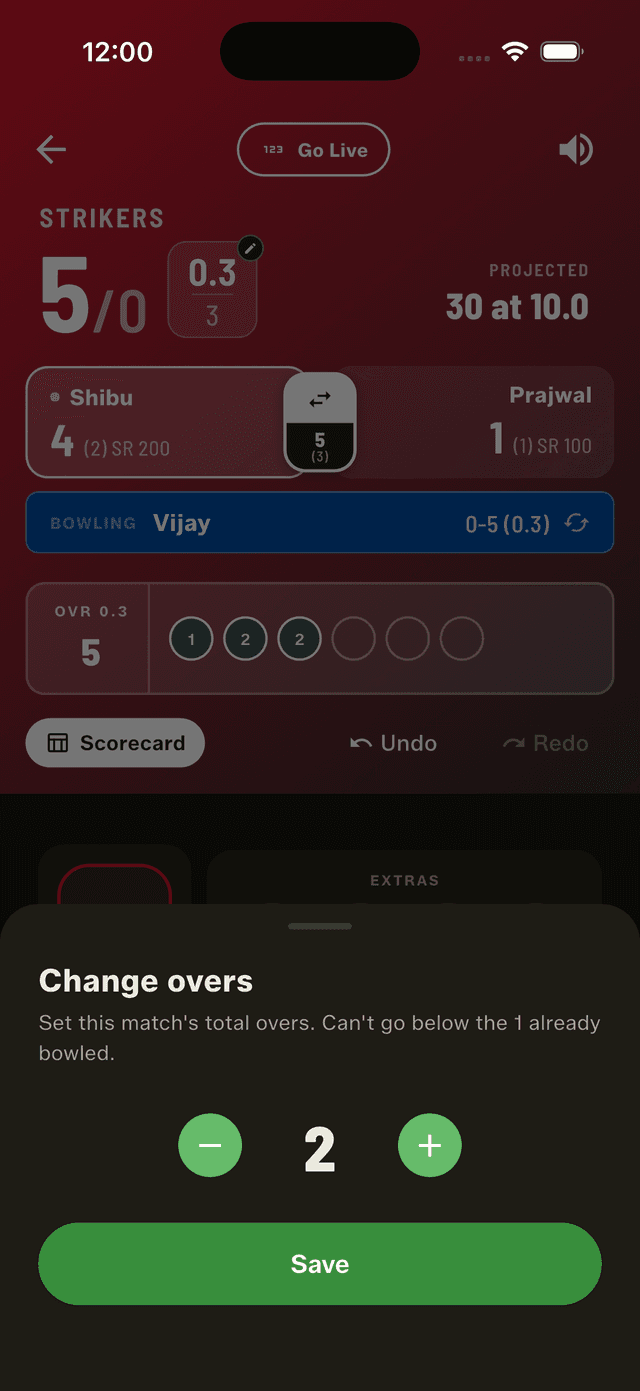
You set eight overs a side, then the light starts to fade, or half the fielders leave, or a five-over slog is suddenly the more sensible game. Turn this on and you can adjust the total overs after the match has started — during the first innings only, so a chase target can never shift underneath the team batting second. It also can't drop below the overs already bowled.
Why it matters: gully games are governed by daylight and attendance, not a fixed schedule. This lets the format flex to reality without abandoning the match and starting again.

The rules GullyCrix settles even without a toggle
A few more things that cause arguments are handled elsewhere in setup rather than in the Gully Rules sheet:
- •Max overs per bowler — a numeric cap (default two) so your quickest bowler can't bowl the whole innings. You can also raise the cap for individual bowlers if your game allows it.
- •Arena & ball type — record whether you're on Turf, Ground, Street, Mohalla or Stadium, and whether it's a Tennis, Tape, Leather, Rubber, Plastic or Wind ball. They're not just labels: every player's career stats can be filtered by them, so you'll finally have proof that your cousin only scores with a tennis ball.
- •Tie-breakers — when scores finish level, GullyCrix can settle it with a Super Over or a Bowl Out, the two ways gullies have always broken a tie.
How to set your gully rules
- 1Start a Full Match (for named players and full scorecards) or a Quick Match (for a fast knockabout).
- 2Open the Gully Rules sheet in setup and flip on only the rules your game plays by.
- 3Agree them out loud with everyone before the toss — that's the whole point.
- 4Score the match; the app quietly enforces every rule you picked, so nobody has to remember or argue.
That's every gully rule GullyCrix supports, first to last. None of them were invented in an office — they were invented in lanes, backyards and turf boxes, by players solving real problems with whatever they had. All we've done is write them down and enforce them fairly. And they travel: the same toggles score backyard cricket in Australia and tape-ball in the UK and the Gulf, because informal cricket bends the same way everywhere. Grab the app, set your gully's rules, and settle the arguments before they start.